Presented at The Latinx Project Graduate Student Working Group‘s second annual symposium at New York University.
Mena Guerrero views the body as the primal interface between the self and the environment. She describes the first instance of knowing you are yourself within your body: “you know your hand, you know your face.”1 But when attempting to find the limits of the self, she proposes, one tends to look towards all those things that we are not, which, if we are to follow what Lacan theorizes, is also how desire is constructed.2 Guerrero builds the Self through networks of relationality and desire. She searches the spaces between bodies and natural phenomena; rather than using them to propose clear delimitations for the Self and the Other, she harnesses these in-between spaces to propose new frameworks in which distinct Selves can blur together in their desiring of each other.
To begin building these liminal space-entities, Guerrero firstly focuses on de-centering the human body, perhaps as a response to the uneven land-body relationships she observes in Central America. She was born in 1996 in Guatemala City, the same year the Peace Accords that officially ended the 42-year Guatemalan Armed Conflict were signed. The Conflict began in 1954 with a U.S.-orchestrated coup that overthrew the Árbenz Guzmán government, whose reforms directly challenged the monopoly that foreign companies had on Guatemalan land. By seeking a community-based redistribution of land, Árbenz Guzmán was a dangerous political threat to both U.S. economic interests and the colonial systems that first established extractive and unidirectional relationalities between the human body and the territory. The coup’s effective suppression of a political reassessment of land distribution practices prolonged the extractive colonial order and the rigid hierarchies it imposed between bodies and territories. Guerrero’s art contests these structures, obstinately rejecting the ideas that a person is defined by how much land they own, that land is only valued for its productivity, and that its fruit is only as worthy as its market value.
In seeking points of contact and exchange between bodies and natural phenomena, Guerrero produces work that relies on repetitive exercises featuring ripe mangoes, human bodies, and volcanoes. Guerrero calls herself a maximalist;3 she uses color richly and eagerly experiments with scale and installation, frequently exhibiting massive bodies of work that can best be appreciated through an extended interaction within the gallery space. In Volcanes, mangos y amor, a recent solo show at La Erre in Guatemala City (fig. 1), Guerrero turned to elements like incense, ash, sparklers, and small clay sculptures to activate the exhibition, thus generating an immersive space in which she places a seedling of curiosity in the viewer’s mind: what feeling comes up precisely upon encountering a smoky hall, filled top to bottom with brightly colored portraits of mangoes, volcanoes, and intertwined human figures?
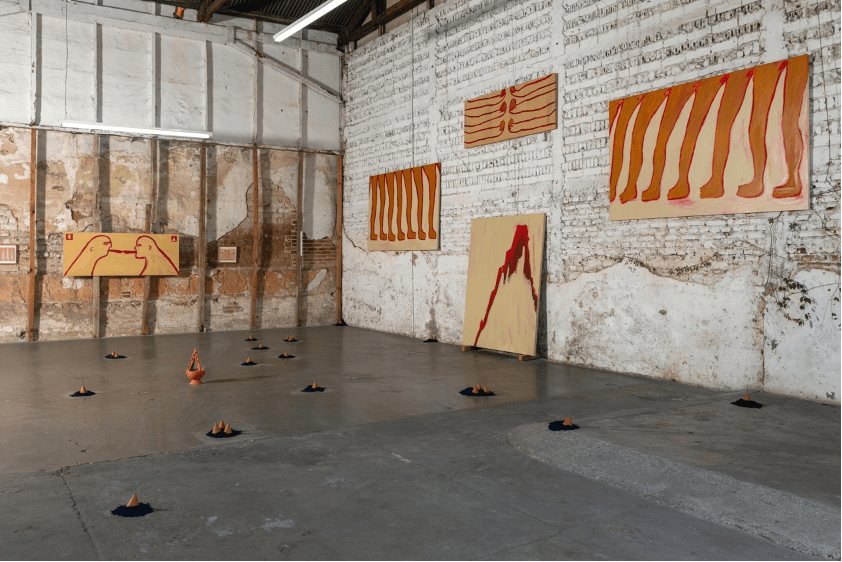
Guerrero intentionally overloads the senses to capture a raw first contact—a vivid feeling—when interacting with her work. The vividness of a feeling, as Peirce proposes, surges in the moments before the primary, unprocessed feeling turns into the consciousness of the feeling.4 Guerrero wishes to capture this instant of contemplation, in which the initial vividness is digested into a recognizable feeling (or firstness is digested into secondness). But the incense smoke, instead of clearing, settles like a shroud into the spaces where the divisions between body, fruit, and landscape would traditionally be found. In some pieces, the figures explicitly overlap each other and merge into hybrid beings; in others, the elements in each scene generate an ecosystem in which they cannot be disentangled from each other.
Amor al Mango (fig. 2) depicts two figures sharing a ripe mango, their hands placed atop a flowered tablecloth as their tongues stretch out towards the brightly colored fruit. In the background, perhaps through a windowpane, two black mountains with fleshy faces flank the sides of three volcanoes, one of which is mid-eruption. While certainly legible as representational, this piece reveals its richness precisely in these liminal spaces where body and nature converge in abstraction. The points of contact in the scene are infinite: the hands on the table, the female figure’s tongue on the skin of the mango, their naked bodies on the green background that could either be a painted wall or a grassy field. What remains salient—and is in fact the clearest way to ground Guerrero’s thinking—is the fact that this piece can be deconstructed and reconstructed at will.
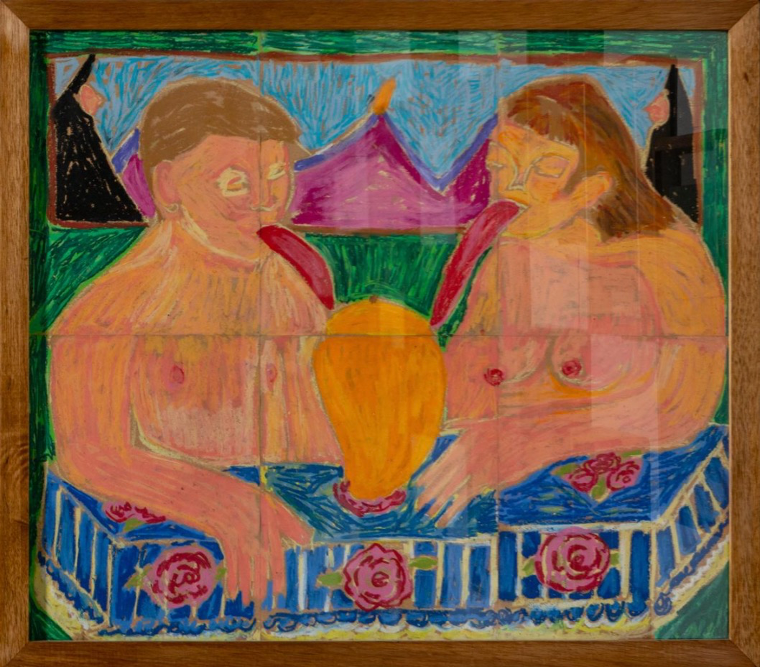
The work is formed by six panels of paper which were completed one at a time. When turned around, each section has a simple, tricolor sketch of a mango (fig. 3). The work has the capacity to become abstract: the artist can manipulate every panel at her discretion, and a trace of this action can be observed by the way the rightmost four sections have been folded and unfolded vertically. The surface of the material becomes a point of contact through which the principal scene can be partially or completely abstracted, whether by a process of rearrangement or simply by flipping the paper around and revealing one or all the mangoes. The abstractable quality of this piece hinges on the fact that everything within it can be compressed into everything else to generate a deeply sensual scene that culminates in the essence of the mango. The contact of skin, the rumble of the earth as the volcano erupts; the smell of sulfur and verdant tropical plants; and the sweet smell of the mango, not yet peeled, but already releasing its fragrant aroma. Guerrero parallels the encounter of the mango and the volcano to the meeting of two lovers:
“First came the volcano, then the mango, then the volcano and the mango met, and the world was made. Now you and I have met, and we feel that this is love, and we want to eat its fruit.”5
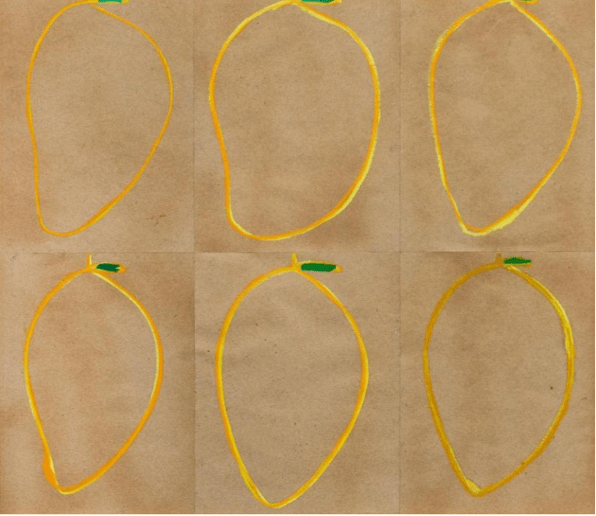
Figure 3: Alternate view, from the series Volcanes, mangos y amor: Amor al mango. 2024.
Oil pastel on kraft paper. 60 cm x 68.5 cm. Image courtesy of the artist.
The seriality of these encounters in her writing mirrors the modularity of the panels themselves, each repetition folding the scene back into a larger, blossoming world. Remembering that the work is embedded in a larger landscape of endless mangoes and volcanoes (fig. 4), it is hence impossible to consider any element in the piece outside of its relation to each other.
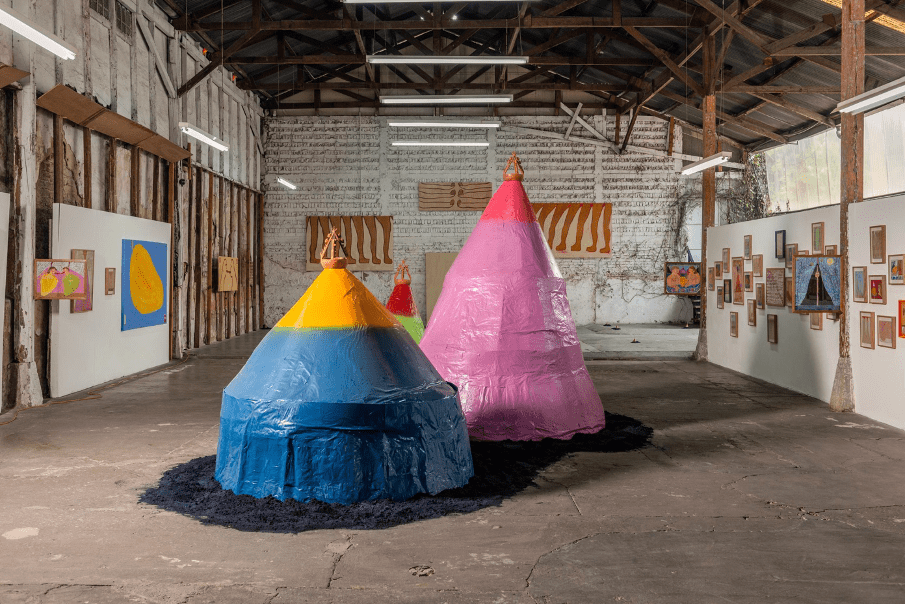
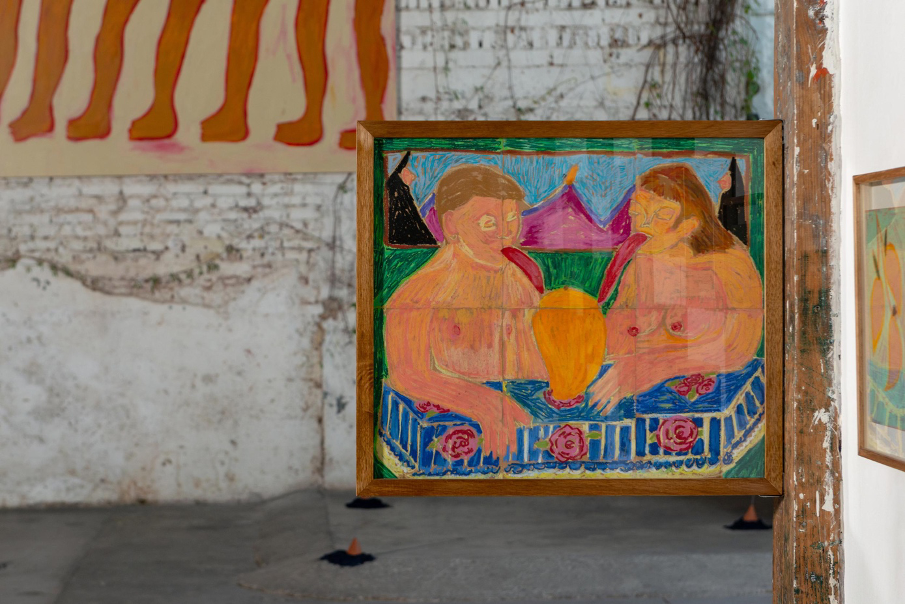
Figure 4: Exhibition views, Volcanes, mangos y amor, 2024. Centro Cultural La Erre, Guatemala City. Image courtesy of the artist.
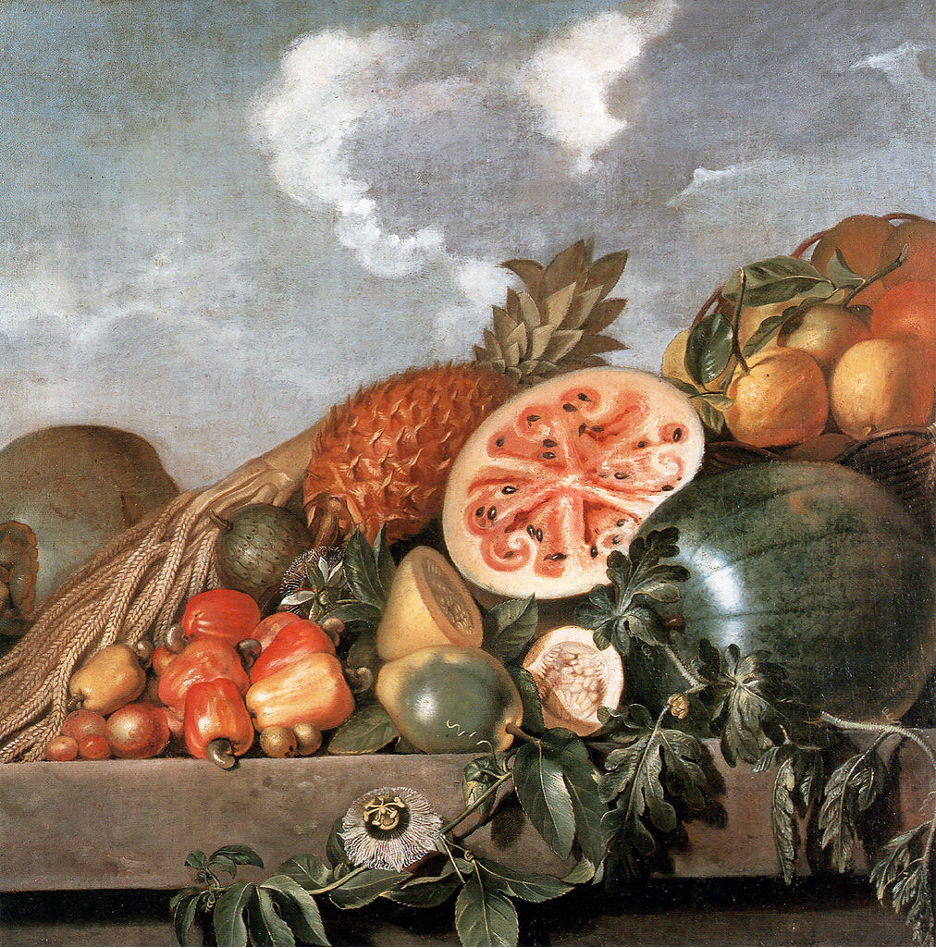
The singular mango at the front, nonetheless, seems to hold a place of privilege in the image, gently balanced upon a rosette as it waits for its flesh to be tasted. It invites the question, then: if the fruit is there to be consumed, why include only one? Why not two, one for each of the characters? One consideration is that the sharing of one mango is visceral and intimate: unlike an apple that can be bitten and passed with minimal dripping, a mango will dribble scandalously after the first bite, with its sweet juices sticking onto the hand of the first taster before it is even handed off. Guerrero, despite all her maximalism, seems to radically reject the idea of agricultural bounty for the sole service of human enjoyment. The refusal of excess is not incidental; it is precisely where her work demands a departure from the colonial visual economies of abundance. For, if the work sought to express the lavish decadence of the fruit, it might resemble Early Modern New World fruit still lifes (fig. 5), where novel tropical crops were plentifully stacked atop each other to emphasize the productive potential of the colonies and encourage extractive economic activities. The mango, though now part of the gastronomic vernacular of the Americas, specifically highlights the transcontinental routes of imperialism—in its case, from South Asia to Mesoamerica. As a single, shared fruit rather than part of a teeming pile, the mango becomes a point from which those histories can be rerouted toward other ways of living with the land. Guerrero’s practice proposes a tangible step towards a decoloniality that prioritizes living with rather than living from the land.
This emphasis of living with mirrors a process of decolonial “re-indigenization” that Carla Macchiavello Cornejo proposes in discussing Cecilia Vicuña’s work, which goes beyond a simple reclaiming of an ethnic ancestry by mestizos, or ladinos in Guatemala, and rather centers a process of “re-educating oneself, both in loving ways and by listening to Indigenous wor(l)ds, paying attention by entering into con/versation with others.”6 Movements of reconnection with the landscape can sometimes veer into the metaphysical, ascertaining that horizontal relationalities are inherently otherworldly or transcendental. But, as Macarena Gómez-Barris exemplifies through Yasuní movements for the preservation of the Amazon, indigenous communities have consistently prioritized horizontality in their engagements with the territory. Indigenous systems of care emphasize the embodied knowledge of regional communities, and the thoughtful agricultural practices endemic to each territory intuitively develop from proximity and familiarity.7 The fruit of the land is thus made to be consumed, but only in the quantity that allows the fruit tree to thrive and be at its most healthy. The mango in Guerrero’s piece is foregrounded as privileged, but its importance does not result in a hierarchical inversion in which fruit rules landscape and human alike, but rather lies within this horizontal framework where person, fruit, and territory live with each other.
Guerrero’s work centers her pluri-ethnic genealogy shaped by processes of mestizaje and routes of migration between Asia, Europe, and the Americas. She articulates her Guatemalan, European, and Chinese cultural identity and transposes it with conversation with contemporary Maya indigenous ways of living, placing particular emphasis on re-establishing relationalities to the landscape based on endemic approaches to inhabiting the Guatemalan territory. Guerrero writes Oráculos de mango as part a series of poetic reflections that interconnect with her artistic practice. Through numbered directions, the artist guides the reader through tenets that propose alternate topographies of relating to one another and the natural world. Much like the elements in her paintings, these thoughts flux and meld into each other, at times clear-eyed and concise while at others obscured and hazy. Number 14, for instance, “Seek to communicate with others who call you in their own languages,”8 recalls plurilingualism as inherent to relationality in the Guatemalan territory, as each way of engaging with the landscape is intimately linked to diverse linguistic communities. Number 6, “The ripe fruit that is not eaten grows rancid,”9 in its obviousness, communicates the idea that the fruit of the earth is destined for its immediate, local consumption rather than its delayed integration into a global export economy. Number 34, “Hold promise with one hand and deliver it to the world with the other,”10 rightly reminds us that networks of desire and affection are ultimately waves of energy, in which the external is translated into the internal, only to be externalized once again. Recalling Lacan, if desire is a way of recognizing the Self as separate from the Other and of wanting what the Other has and the Self lacks, then Guerrero redefines it: desire becomes a search for liminal points of contact where the edges of Selfhood blur, generating a practice of radical empathy that makes it possible for the Self to identify with the Other.
Mena Guerrero’s artwork builds a universe in which possibilities for desire and relationality expand beyond the established limits of the Self and the Other. She manifests a space where a woman can engender a mango in her womb to call on a lover (Me dibujé un mango en el vientre, para evocar tu engedro),11 while also being born from the core of a raging volcano (Soy una niña volcán. Soy una niña en un paisaje de humo. Una niña destrucción).12 Guerrero suggests that if the body can become fruit, fire, and soil, then the core of the earth itself can be embodied. In a move against the colonial disaffection between the human body and the natural world, Guerrero’s practice imagines not only an empathetic relationship with the landscape, but a true identification with it.
She tells us, “We have the recipe: volcanoes, mangoes, and love.”13
- Mena Guerrero in discussion with the author, November 2025. ↩︎
- Jacques Lacan, My teaching, trans. David Macey (Verso, 2008): 38. ↩︎
- Guerrero in discussion with the author. ↩︎
- Charles Sanders Peirce, The Collected Papers Vol. I: Principles of Philosophy (Harvard University Press, 1931): 153. ↩︎
- Mena Guerrero, «Y se hizo el mundo» (unpublished poem, 2023 – 2024). Author’s translation. ↩︎
- Carla Macchiavello Cornejo, “A New Spelling for EVOLve: Feel Love,” in Momentum: Art & Ecology in Contemporary Latin America (Museum of Modern Art, 2024): 125. ↩︎
- Macarena Gómez-Barris, The Extractive Zone: Social Ecologies and Decolonial Perspectives (Duke University Press, 2017): 20. ↩︎
- Mena Guerrero, «Oráculos de mango» (unpublished poem, 2023 – 2024). Author’s translation. ↩︎
- Guerrero, “Oráculos de mango”. ↩︎
- Guerrero, “Oráculos de mango”. ↩︎
- Mena Guerrero, «Me dibujé un mango en el vientre» (unpublished poem, 2023 – 2024). “I drew a mango on my womb, to invoke your spectre.” Author’s translation. ↩︎
- Mena Guerrero, «Niña Volcán» (unpublished poem, 2023 – 2024). “I am a volcano child. I am a child in a landscape of smoke. A destruction-child.” Author’s translation.a Guerrero, «Niña Volcán» (unpublished poem, 2023 – 2024). ↩︎
- Guerrero, «Y se hizo el mundo.» ↩︎
