For Isabel Ruiz (b. Guatemala City, 1945), art became the only way to soothe the open wounds left by life during the Guatemalan Armed Conflict.1 She traces this realization to a student art trip to Rabinal2 in the mid-1960s, where she first observed local artisans carving traditional jícaras, their hands roughened and marked by agricultural labor. The act of carving out shapes on the surface of the jícaras seemed to her like light shining through darkness, something she had long been devoted to seeking in her own practice. At this point in her career, Ruiz had been working mostly in watercolor landscapes, a versatile medium through which she documented the topographical and social textures of a country on the cusp of war. Her commitment to depicting the living reality of Guatemala in the 1960s resulted in landscapes that, according to her fellow artist Marco Augusto Quiroa, “tear and shudder” in their aggressive coloring and urge to rupture “molds and pre-established concepts”.3 Her instructor and mentor Roberto Cabrera went further, arguing that her landscapes authentically captured the nature of a relentless tropic.4 For Ruiz, however, watercolor lacked a purgative aspect. The jícaras sparked an interest in gouging, carving, and ‘hurting’ the material to produce striking images. Working from her own wounded hands, she was eager for the possibility to exert violent pressure and in return release a light.
Intaglio printmaking introduced Ruiz to burins and zinc plates, which provided cathartic spaces where she could scratch and pound at the matrices, flood them with ink, and crush them under the press to produce pieces that viscerally responded to the collective Guatemalan experience in an age of repression and violence. Between the 1970s and 1990s, she produced prints prolifically, building a strong community of fellow artists and thinkers committed to creating spaces for artistic dialogue that critically engaged Guatemala’s shifting sociopolitical landscape. Printmaking allowed Ruiz to construct a practice through which she could release pain, document it, and then heal it through collective discourse and community—an approach which later carried over into her broader multidisciplinary work encompassing print, performance, and conceptual art. By understanding printmaking as a process of transferring ink via a matrix onto a support through pressure,5 I argue that it functioned as an extended framework for Ruiz to explore catharsis, memory, and healing. Starting from a close look at her print practice and then engaging closely with her subsequent non-print works, I will trace the different ways printmaking manifests in her multidisciplinary career. I propose that her later non-print works can be understood as a prolonged act of grabar—emphasizing the denotative multiplicity of this term: to make a print and to record—and that Ruiz herself can be considered a grabadora: both a printmaker and a recorder.
In 2008, Ruiz engaged in a conversation with curator Anabella Acevedo as a part of Colección Pensamiento II, an ongoing publication series that aims to provide platforms for critical thought by placing scholars, artists, and thinkers in dialogue with each other. For this iteration, the guiding idea was to reveal alternate visualizations of Guatemalan reality, put forth by people who possessed a “lucid” perspective of the society they inhabited.6 At that point, Ruiz was a household name in the Guatemalan contemporary art scene. She was teaching studio classes at the publicly managed Centro Cultural Municipal,7 which remains at the epicenter of artistic dialogue in the country. Internationally, her groundbreaking trajectory dealing with memory and the Armed Conflict had consistently afforded her significant opportunities for exhibition across Latin America, the US, Europe, and Taiwan.8 The interview between Ruiz and Acevedo, which I engage extensively in my research, emerged at a crucial point from which she could look back at the shifts in her practice, conversationally weaving the different threads into each other to explore the bigger questions behind her later investigations in conceptualism and performance.
The exchange starts, quite naturally, with Ruiz’s memories of childhood. She grew up in Zone 3 of Guatemala City, the oldest and only woman amongst five siblings in a working-class family. While she walks Acevedo through her home life, Ruiz establishes something quite quickly: she had always been a careful, yet sharp, observer of her environment. We learn, for example, how her first foray into artmaking arose from her father’s profession as a shoemaker. She was drawn to his transformations of two-dimensional drawings into shoes “as if they were a sculpture.”9 This genealogical link, however, did not translate into a fertile ground to develop as an artist. Her father was her principal critic, telling her that, as a “poor woman”, she would be better off learning how to cook and clean to find a man to keep her.10 Although throughout the text Ruiz consistently expresses appreciation for her family, including a deep understanding for her father’s own suffering, she concludes that he fell into the role of the “dictator in power”: a man doomed to replicate in his household the social and political violence in Guatemala.11 The manner in which Ruiz continues narrating her youth clearly reflects sixty-three years of a thoughtfully meditative life praxis wherein she traces not only her lived experiences, but the history of her country. Her most vivid personal memories—her first period, the jobs she took to afford her artistic education, and even her wedding—are superimposed with powerful contemplations and critiques on the Conflict, womanhood, and class in Guatemala. Her impulse to document memory, or to grabarla,12 was guided by a deep sense of empathy that generated an inextricable relationship between her own lived history and that of her country. As Rossina Cazali tenderly puts it, “She cared so much about the fate of this país-pueblo, and her work was an avenue to show it.”13
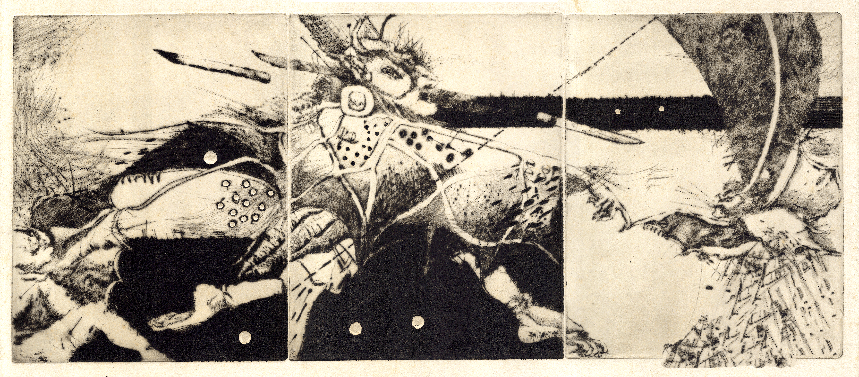
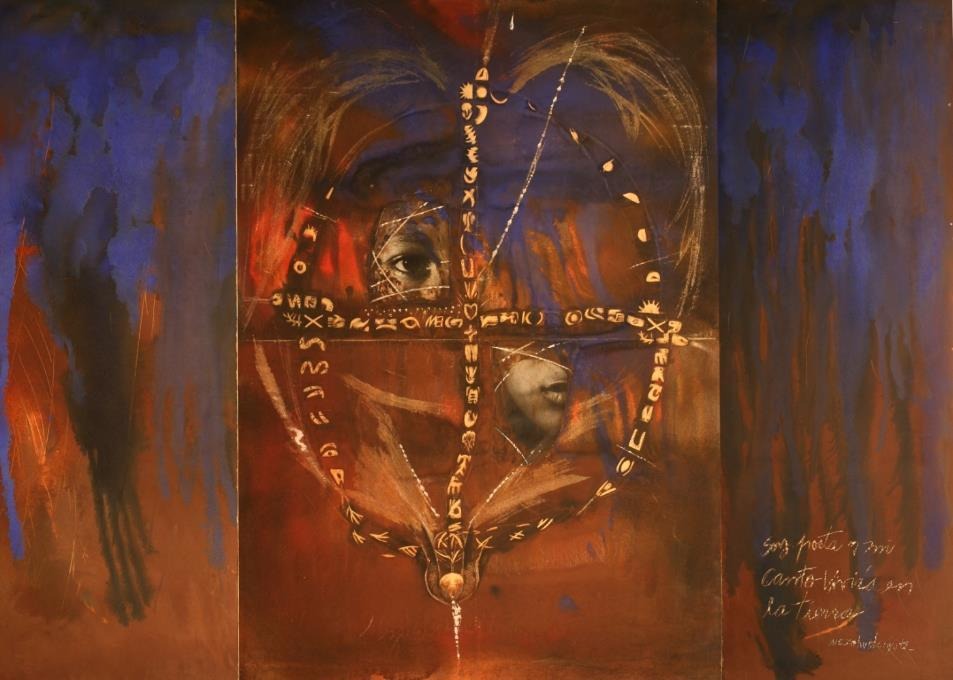
The series Rio Negro (1982 – 1997, fig. 1) is part of a large body of work through which Ruiz responds directly to a period of the Conflict when death, disappearances and repression increased as the military dictatorship was threatened by movements to reinstate democracy in Guatemala. The piece consists of three different print plates pressed onto a singular sheet of paper, generating a triptych-like layout that makes up a single scene that alludes to the massacre of Río Negro in Chixoy in the early 1980s.14 Although undoubtedly an implementation of grabado as in to document, closely studying prints such as this is crucial to reveal the ways that Ruiz harnessed the process of printmaking beyond the press. Isabel Ruiz first interacted with woodblock printmaking at the Escuela Nacional de Artes Plásticas (ENAP) between 1964 and 1968. At the ENAP, printmaking was foundational not as an expressive medium, but as a key training to later be used in graphic design, advertising and other technical careers. Given her aptitude for illustration and xylography, her professors encouraged her to work with precise perfection. Ruiz confessed to Acevedo that she could not follow their counsel—she felt the need to do everything aggressively and loved “wounding” the wood with her tools.15 In the late 1970s, her fellow artist Moisés Barrios carried a printing press all the way from Madrid, Spain to Guatemala City. While they had only met briefly a few years before when they were both in San José, Costa Rica, Barrios was generous with his knowledge and equipment and readily induced Ruiz into the field of intaglio. She promptly grew to prefer this medium over other forms of printmaking. She experimented with both acids and drypoint etching, the latter of which would largely dominate her print practice. Drypoint has the benefit of working much like drawing does: using the burin lightly results in a dynamic, supple line, and applying more force produces heavy, black marks. In Río Negro, this range of line weights gives way to an image that, although seamlessly connected in form, evokes a disjointed triptych where the central figure is caught in between light and dark, or perhaps, life and death. Ruiz’s explorations of the range of possible pressure in drypoint allowed her to discover the different purgative capabilities of the engraved line, and thus, articulate also her identity as a grabadora.
Looking at a close-up of her 1982 Personaje (fig. 2),16 it becomes more evident how the dense black of the background in Ruiz’s print pieces was produced not by letting acids eat away at the zinc, but by applying a considerable force on the burin and the plate when creating the interlocking lines that conform it. This contrasts with a print such as Cabeza con Árbol (1982, fig. 3), where the consistent tones in the darker areas were likely achieved through aquatint. The tight crosshatching in Personaje conjures a vivid image of Ruiz hunched over her matrix, burin held like a pencil, pressing down with all her strength to ensure an airtight black (fig. 4).
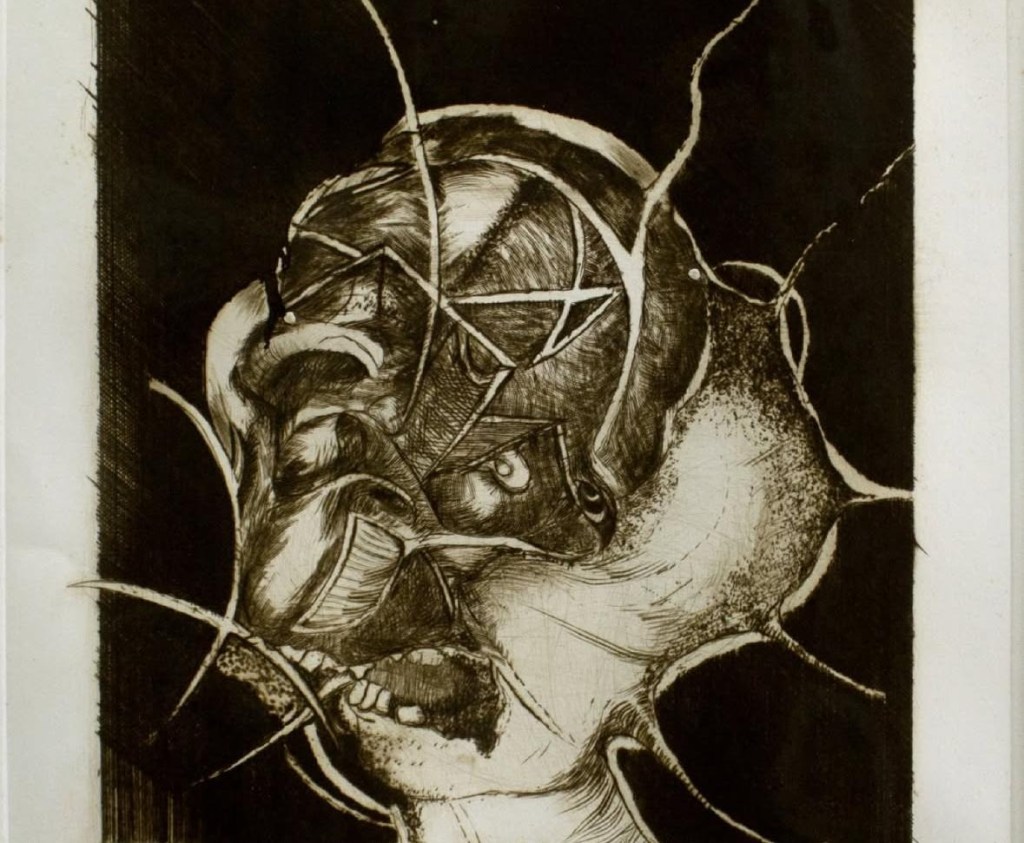
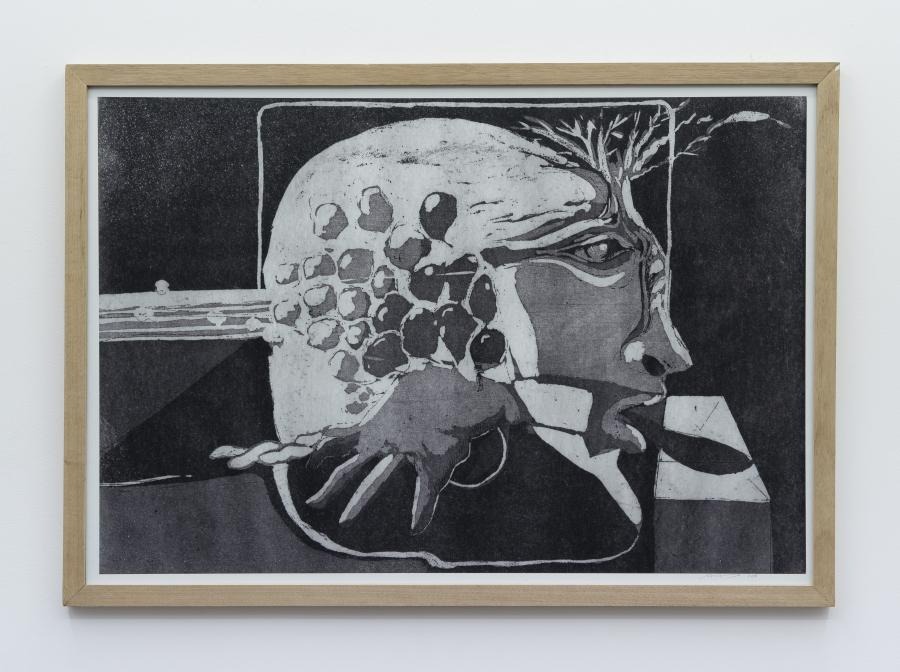
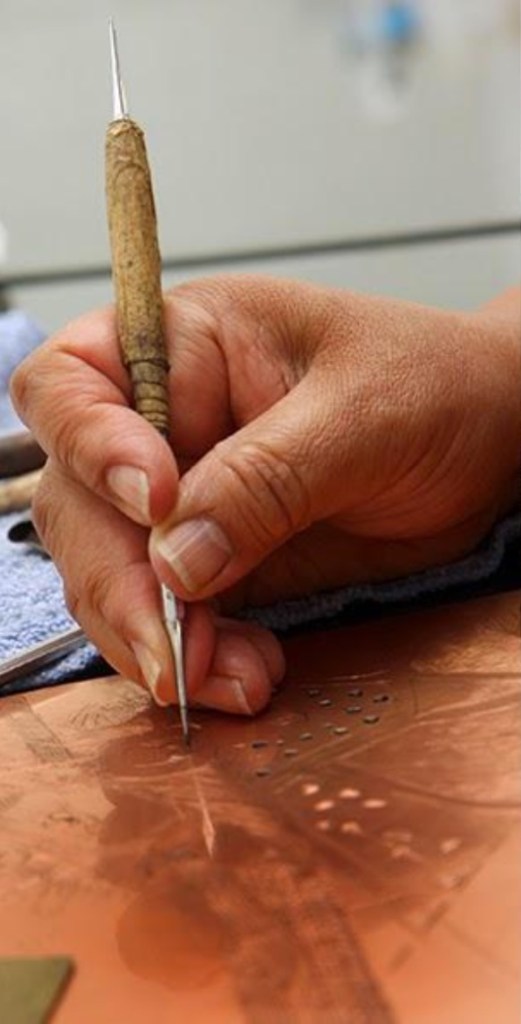
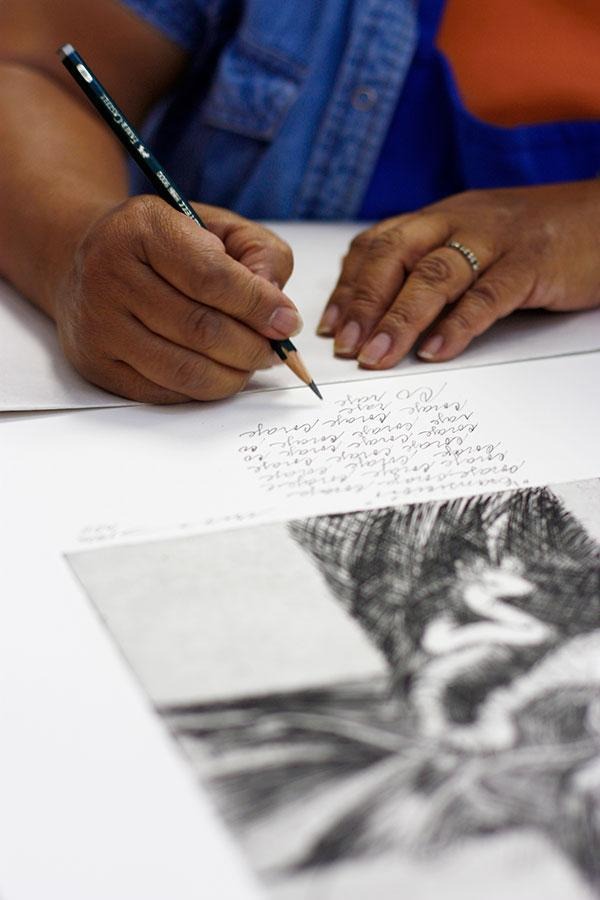
Figure 4: Left, Isabel Ruiz etching a copper plate, 2011. Right, Isabel Ruiz handwriting on an editioned print, 2011. Images © Oswaldo J. Hernández.
With a scene such as this one in mind, it becomes crucial to ask: where does this insistent need for release and catharsis come from? What led her to seek a medium that responds directly to the force of her hand? Rossina Cazali argues that Ruiz intensely felt her condition as a woman, and Vania Vargas complements this by stating that Ruiz renounced the woman artist’s “right” to contemplation and the transmission of beauty, choosing instead to translate the repression and “horrors” of life in Guatemala.17 What Vargas overlooks is that Ruiz did not work from a neutral context from which she could simply opt to depict “horror” over flat still lifes and landscapes, but rather from a position of intimate exposure to classed and gendered violence under the military dictatorship. Ruiz’s urge to visualize the lived reality of the military dictatorship came from a profound identification with ongoing injustices; the fear, anger, and loss she felt were, in her view, shared by many others.18 She was indignant at the notion that “poor women”19 like her should internalize the emotions derived from the death and violence happening around them, and meekly focus on marrying well to make it through the war. As art critic Juan B. Juárez rightly states, “Isabel Ruiz […] does not depict rage. She is the voice of rage.”20 Ruiz’s womanhood was brimming with an ire that she harnessed into an expert intaglio practice that eventually guided all aspects of her artmaking.
Her first explorations of the possibilities of printmaking beyond the matrix were regrettably forced upon her by a series of health complications from the acids. She was prevented from interacting extensively with the medium, which in the late 1980s and early 1990s brought her back to watercolor. Ruiz, however, was adamant to give up the opportunities for catharsis that printmaking provided. She took burins and knives to thick watercolor paper and found that the paper acted similarly to a zinc plate; she could gouge part of the material out and apply watercolor on top to reveal the image itself. She incorporated other tools like steel wool, cutlery, and even her own fingernails to tear at it, pushing at its limits to find new possibilities of transparency. The early 90s were an era when Guatemala was slowly transitioning out of the military dictatorship and into their first democratically elected government since 1954. While still a time of uncertainty, artists and cultural practitioners found avenues to generate emergent expositive spaces that encouraged artistic experimentation and critical dialogue. Ruiz, who was encouraged by the newfound flexibility of watercolor and excited to engage in these artistic conversations, incorporated larger scales and provocative elements such as lightboxes and fire into the presentation of her works. The pieces she created through these investigations in material, such as the continuation of her series Río Negro (1982 – 1997, fig. 5) and Historia Sitiada (1995, fig. 6), foreground her later interest in performance and further experimentation in installation.
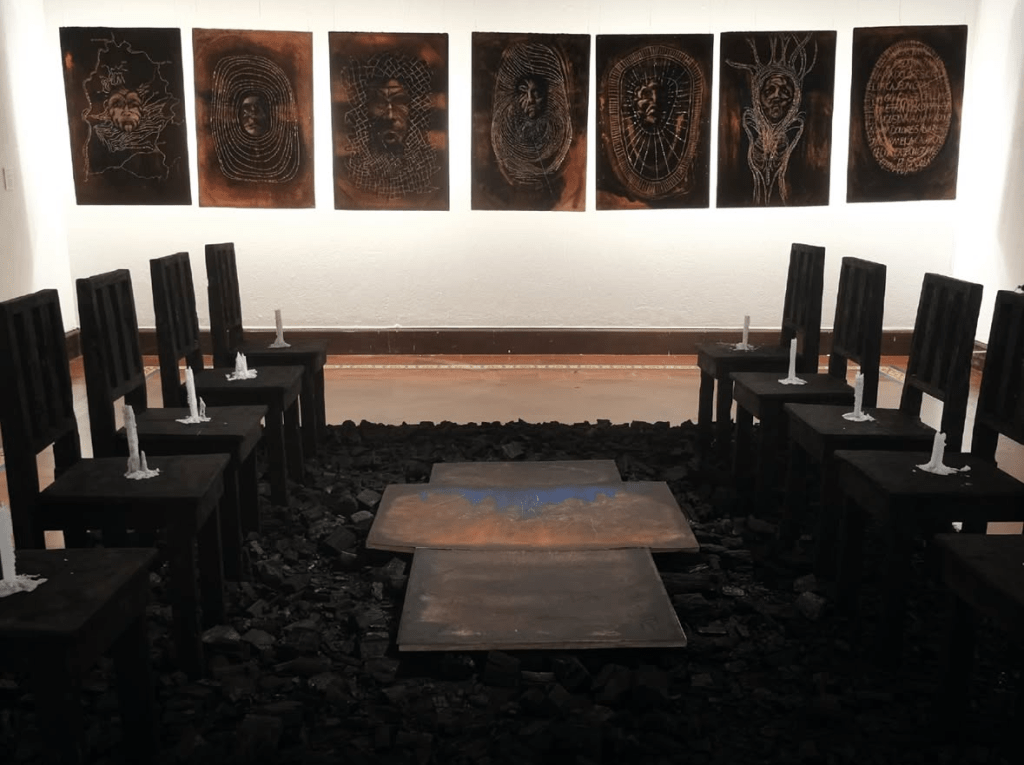
The slow end of the Armed Conflict culminated with the 1996 Acuerdos de Paz (Peace Accords) between the Guatemalan government and the Unidad Revolucionaria Nacional Guatemalteca.21 This unleashed a series of internationally guided processes that sought to impartially expose the scale of the human rights violations and violences perpetuated between 1954 and 1996,22 which resulted in the publication of the report Guatemala, memoria del silencio by the Comisión para el Esclarecimiento Histórico (CEH)23 in 1999. Ruiz’s husband, poet Francisco Morales Santos, was the main style editor for this report. Ruiz’s relationship with her husband was founded upon an idea of artistic and literary companionship: Morales Santos would often ask for her feedback on poems and other texts, which is likely how she came to interact with Guatemala, memoria del silencio at a point before its publishing.24 The testimonies featured in the report are graphic in their detail, describing the deaths and disappearances through over one hundred illustrative cases used to support the CEH’s goal of presenting an “authentic chapter of Guatemalan history” to the wider public.25
Despite having experienced the displacement, violence, and repression of the Armed Conflict firsthand, reading Guatemala, memoria del silencio exposed Ruiz to histories that she would not have heard otherwise. The report laid bare the artifacts of terror that the military forces deployed in even the most remote places of the country, and Ruiz felt the need to seek a way to further document these accounts and make them even more visible—something which was pointed, bruising, and unignorable. She completes Test-imonios: Pañuelos (2002, fig. 7) only three years after Guatemala, memoria del silencio was published. This work consists of a collection of white handkerchiefs hung on a clothesline upon which she transcribed different statements included in the report. As theorized by Diana Taylor, memory is embodied and sensual26 in both the way it is invoked and internalized. Pañuelos urges the viewer to not only imagine the artist’s productive process of writing on the cloth’s surface, but to embody the histories and testimonies themselves. The handkerchiefs hang, waiting, perhaps for a tear to be shed and wiped away with one of their corners. The surface of the thin cotton cloth was to Ruiz like an echo of flesh—the handkerchief, by receiving the bodily fluids produced by pain, becomes an extension of the grieving body, absorbing tears, muffled sobs, and blood alike.
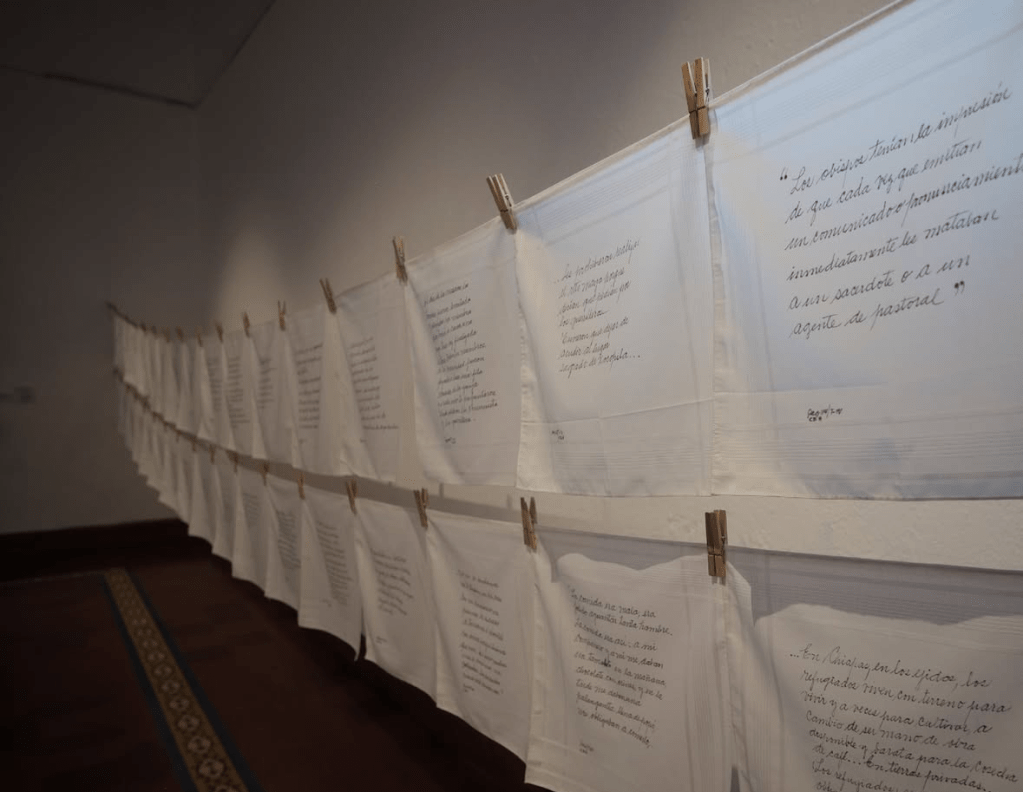
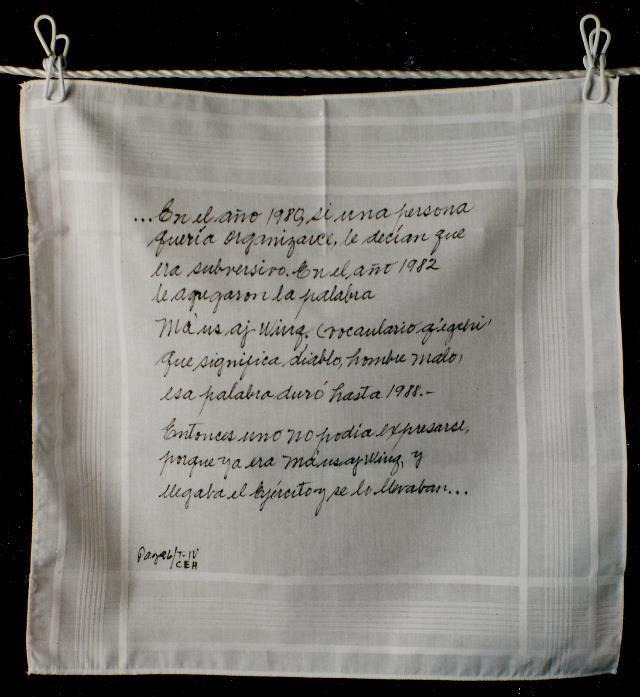
Figure 7: Isabel Ruiz. Test-imonios: Pañuelos, 2002. Installation, ink on cloth. Variable dimensions. Image courtesy of the artist via Gabriel Rodríguez Pellecer.
Pañuelos operates as a continuum between the “live present and living past”27 of not only post-war Guatemala, but also Ruiz’s printmaking practice. Embodied knowledge, also as proposed by Taylor, eludes the precise temporalities of the “here/now and the there/then.”28 Considering Ruiz’s print practice as something more akin to embodied knowledge allows for a reading of Pañuelos in which—although not directly engaging a burin, a plate, or a press—the artist herself embodies the printmaking process. She becomes the matrix upon which the words of the testimonies were etched. She welled these wounds with ink that she pressed, and literally printed, onto the support of the white handkerchief. The resulting print is an additional tangible record of the living memory of the people whom the war had tried to terrorize into silence, documented in Ruiz’s slanted cursive.29
The temporality of the piece coincides with a time between the 90s and early 2000s where the levels of violence perpetrated/experienced during the armed conflict were put in question by certain sectors of Guatemalan society, even after the widespread publication of Guatemala, memoria del silencio.30 Pañuelos aligns precisely with what Kency Cornejo calls “visual disobedience”—an act that defies both state repression and inherited colonialities in Central America.31 Ruiz recognizes the hegemonic bid for the invisibilization of largely indigenous accounts of systemic violence and proposes Pañuelos as a radically disobedient piece that makes the lived realities of the Armed Conflict hyper-visible.
Six years later, Ruiz produced Matemática sustractiva: Homenaje a Luis de Lión (fig. 8). Much like Pañuelos, it explicitly deals with the various data reports issued post-Armed Conflict, but the radical shift of the scale and method she employs produces a piece that further emphasizes the sheer magnitude of the uncertainty and repression of the Armed Conflict. In 2008, Ruiz had been experimenting with ideas of engaging the body in her art, and Matemática sustractiva emerged as one of her first investigations into performance. The piece consists in the artist approaching an exterior wall with a piece of common chalk in one hand and a damp rag in the other. She begins by scratching lines on the stone surface. Upon reaching four, she seals the group off with a transversal fifth line. Ruiz repeats this process until there are 45,000 small lines on the wall, corresponding to the estimated number of victims of the Conflict.32 Tracing her steps back, she then takes the rag and erases every mark, only to start the process all over again. While Pañuelos amplifies the presence of the surviving victims, Matemática sustractiva emphasizes the phantom existence of those who cannot relay their testimonies firsthand. Matemática sustractiva abstracts the victim by turning each number into an individual, yet undifferentiable, tally mark. However, when juxtaposing this with the piece’s dedication to her close friend Luis de Lión who disappeared in 1984, the piece reminds the viewer that each of these unidentifiable tally marks represents a victim, yes, but it foremostly manifests a loved one.
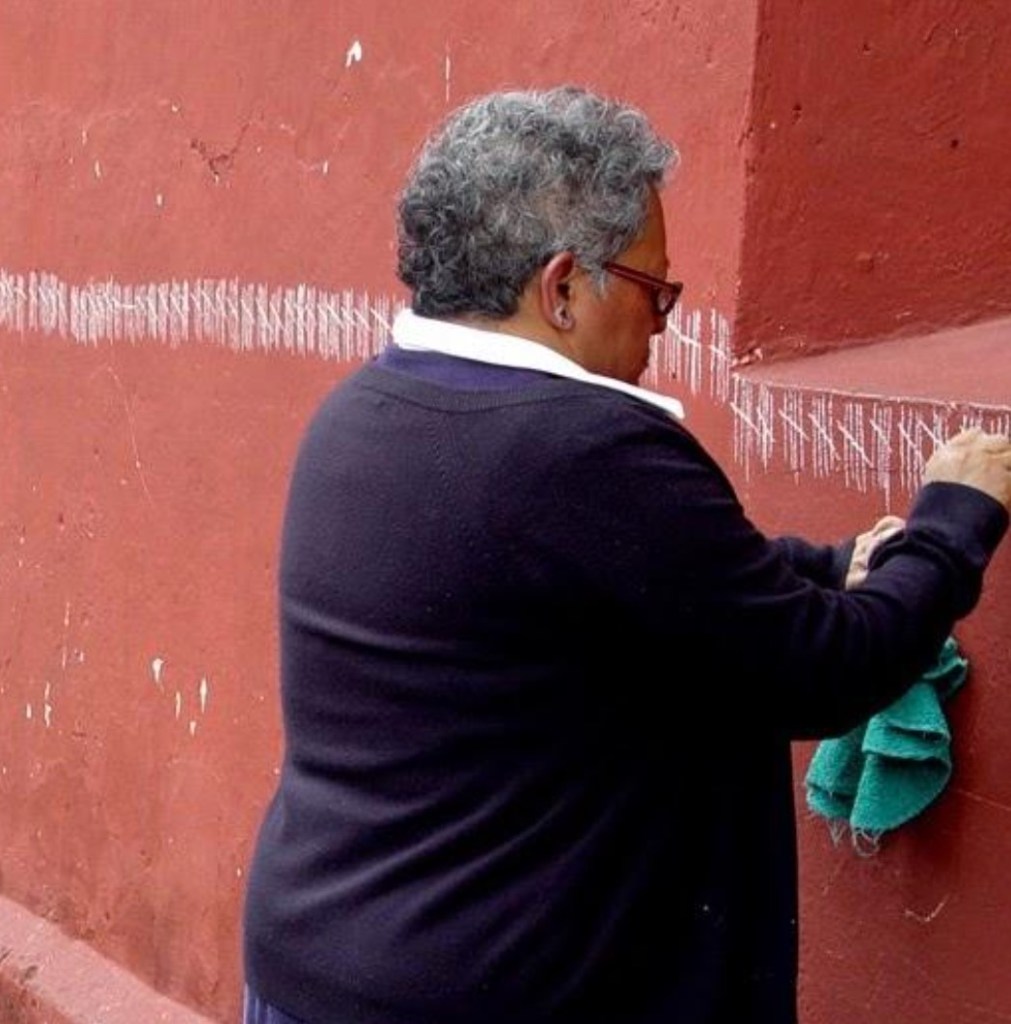
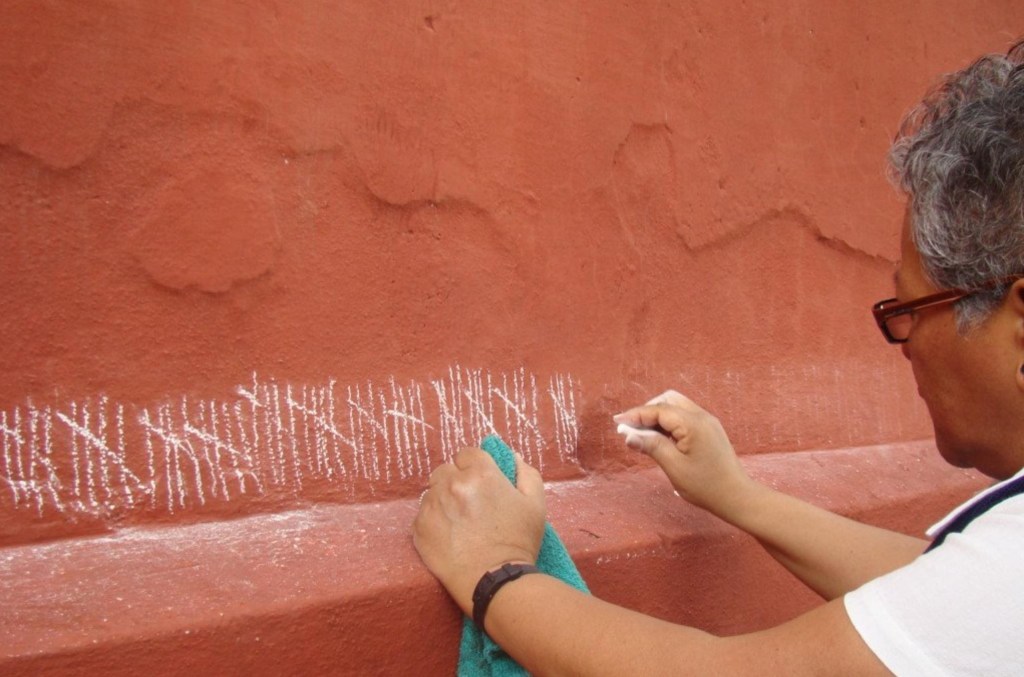
Figure 8: Isabel Ruiz. Matemática sustractiva: Homenaje a Luis de Lión, 2008. Performance. Image courtesy of the artista via Gabriel Rodríguez Pellecer.
The repetitive action of etching lines and then erasing them for unidentifiable periods of time additionally recalls the printmaking notion of a “multiple original”—or a work of print executed by the same printmaker, from the same matrix.33 In contemplating this reading of Matemática sustractiva it is important to consider that printmaking is a mechanical, not automatic, process, which reminds that each edition of a print is liable to minimal disparities which can stem from matrix wear, ink density, placement of the matrix on the paper, and other variables. With each ‘reprint’ from Ruiz’s chalk, Matemática sustractiva replicates the previous iteration of the 45,000 tally marks on the support of the wall. The stroke, however, will always differ slightly, both due to human variance and the fact that as Ruiz presses down on the chalk stick, the shape of her tool changes and naturally varies her stroke. The chalk leaves behind a spectral mark even after being wiped off, and with every new ‘edition’ the tally marks gather a ghostly halo of all the versions that came before them. Wearing away at chalk stick after chalk stick, Ruiz enacts her role as a grabadora, both as a printmaker and a recorder. Each etched ‘print’, always echoing the last, forcefully reminds that documenting post-war memory is a repetitive, tireless effort. But Ruiz, endlessly performing the printmaking process, wound back the tape and played it back in a gesture that insists each victim must be found, named, and granted due justice. As a twofold grabadora, Isabel Ruiz worked from a fervent passion to both record and surface the buried wounds of post-war Guatemalan society. In works such as Pañuelos and Matemática sustractiva, Ruiz sought collective processes of healing that prioritized highly visible traces of memory—compelling records that disallowed any attempt to minimize the tangible effects of the military dictatorship. Her consistent driving force, nonetheless, was the overarching notion of catharsis through artmaking. For Ruiz, printmaking presented an action commensurate to cutting open her chest and removing from its cavity her innermost sadness, empathy, and rage. Initially, printmaking allowed her to release the cumulative hurt of her formative years, of coming of age with the establishment of the military dictatorship, and of maturing as an artist during a time of terrifying uncertainty. Yet, in between her decades-long explorations of the purifying possibilities of light strokes and forceful pressure; of ripping and gouging; of hurting the material, she found that she “no longer cared” about her “individuality”.34 Isabel Ruiz was empathetic to a point that was painful. Her radical sense of care for both her surrounding community and the people of her country fundamentally anchored her hurt, empowering her to produce a practice that unapologetically visualized, through ink or any other medium, the ‘memoria del silencio’35 of Guatemala.
- The Guatemalan Armed Conflict began in 1954 with the CIA-orchestrated coup of President Jacobo Árbenz Guzmán. Between 1954 and 1996, it is estimated that around 200,000 people died and 45,000 were disappeared (according to the UN-funded Commission for Historical Clarification in Guatemala). ↩︎
- Rabinal is a town in the department of Baja Verapaz, towards the central highlands of Guatemala. ↩︎
- Francisco Morales Santos, “Isabel Ruiz, notas biográficas,” Narrativa y ensayo guatemaltecos, January 18, 2020, https://www.narrativayensayoguatemaltecos.com/isabel-ruiz-notas-biograficas/. ↩︎
- Morales Santos, “Isabel Ruiz, notas biográficas.” ↩︎
- Jennifer L. Roberts, Contact: Art and the Pull of Print (Princeton University Press, 2024): 13. ↩︎
- Jorge Castrillón Castán, “Preface” in Colección Pensamiento II (El Librovisor, 2008): 6. ↩︎
- The Centro Cultural Municipal is a government funded cultural space that offers courses across music, dance, and the plastic arts for adults and children. It counts with rich cultural programming that typically brings together artists, curators, and scholars from across the Central American Region. The Centro Cultural Municipal also produced Isabel Ruiz’s posthumous retrospective, Lo efímero no cuenta in 2024. ↩︎
- “Isabel Ruiz: Curriculum,” Museo de Arte y Diseño Contemporáneo, accessed December 3, 2025, https://madc.cr/es/node/1806. ↩︎
- Isabel Ruiz and Anabella Acevedo, “El arte como estrategia de sobrevivencia: Isabel Ruiz conversa con Anabella Acevedo,” in Colección Pensamiento II (El Librovisor, 2008): 8. ↩︎
- Ruiz and Acevedo, “El arte como estrategia de sobrevivencia,” 9. ↩︎
- Ruiz and Acevedo, “El arte como estrategia de sobrevivencia,” 10. ↩︎
- Grabar[la memoria]. To document [memory]. ↩︎
- Rossina Cazali, Gabriel Rodríguez Pellecer, Vania Vargas and Jorge de León, Isabel Ruiz: Lo efímero no cuenta, exh. cat. (Centro Cultural Municipal, 2025). ↩︎
- The Commission for Historical Clarification (CEH) established that in 1982, 177 people from the community of Río Negro in Baja Verapaz were arbitrarily murdered by a Xococ-based patrol crew sponsored by the Guatemalan Military. This case was also tied to land-based conflicts, in which the community of Río Negro was labeled as guerilla-sympathizing after the resisting the construction of a hydroelectric plant in their lands. The CEH concluded that this tragedy demonstrates how civilians were needlessly implicated in the violence of the Conflict. ↩︎
- Ruiz and Acevedo, “El arte como estrategia de sobrevivencia,” 26. ↩︎
- A challenge I came across during this project was finding high quality images of Ruiz’s prints. While her practice was heavily productive of all sorts of two-dimensional media, including watercolors, prints, and drawings, very few are documented in high enough quality to facilitate their digital study. ↩︎
- Vania Vargas, “Isabel Ruiz: El arte es una crónica del hallazgo de la luz,” Revista Gimnasia, April 25, 2015, https://revistagimnasia.wordpress.com/2015/04/25/isabel-ruiz-el-arte-es-una-cronica-del-hallazgo-de-la-luz/. ↩︎
- Ruiz and Acevedo, “El arte como estrategia de sobrevivencia,” 17. ↩︎
- Echoing her father’s words. Ruiz and Acevedo, “El arte como estrategia de sobrevivencia,” 9. ↩︎
- Vargas, “Isabel Ruiz: El arte es una crónica del hallazgo de la luz.” ↩︎
- The Unidad Revolucionaria Nacional Guatemalteca was a political party established in 1982 after four distinct Guerrilla groups joined forces. ↩︎
- Comisión para el Esclarecimiento Histórico, Guatemala, memoria del silencio, Tomo I (Oficina de Servicios para Proyectos de las Naciones Unidas, 1999): 15. ↩︎
- The CEH was commissioned by the United Nations in the late 80s. ↩︎
- Francisco Morales Santos, “Entrevista Francisco Morales Santos, Exposición Lo efímero no cuenta de Isabel Ruiz,” interview by Centro Cultural Municipal, Guatemala City, August 2025, 4:15, https://www.youtube.com/watch?v=A49117QBc1M. ↩︎
- Comisión para el Esclarecimiento Histórico, Guatemala, memoria del silencio, Tomo I, 16. ↩︎
- Diana Taylor, The Archive and the Repertoire: Performing Cultural Memory in the Americas (Duke University Press, 2003): 82. ↩︎
- Following Taylor’s wording. Taylor, The Archive and the Repertoire, 82. ↩︎
- Taylor, The Archive and the Repertoire, 82. ↩︎
- Comisión para el Esclarecimiento Histórico, Guatemala, memoria del silencio, Tomo V: Conclusiones y recomendaciones (Oficina de Servicios para Proyectos de las Naciones Unidas, 1999): 78. ↩︎
- Especially right-wing Guatemalans and those with social and familial ties to the Guatemalan military. This is a divisive topic that is still constantly debated. ↩︎
- Kency Cornejo, Visual Disobedience: Art and Decoloniality in Central America (Duke University Press, 2024): 10. ↩︎
- Cazali, Rossina, and Mercedes Florez, Los Desaparecidos: Horror Vacui, exh. cat. (Espacioce!, 2008): 34. ↩︎
- Hortensia Mínguez García, «Copia versus original-múltiple. Una relación dialógica en el arte gráfico reproducible.» Arte, Individuo y Sociedad 25, no. 1 (2013): 77 – 93. http://dx.doi.org.ezproxy.lib.utexas.edu/10.5209/rev_ARIS.2013.v25.n1.41165. ↩︎
- Ruiz and Acevedo, “El arte como estrategia de sobrevivencia,” 42. ↩︎
- Memory of silence. ↩︎
