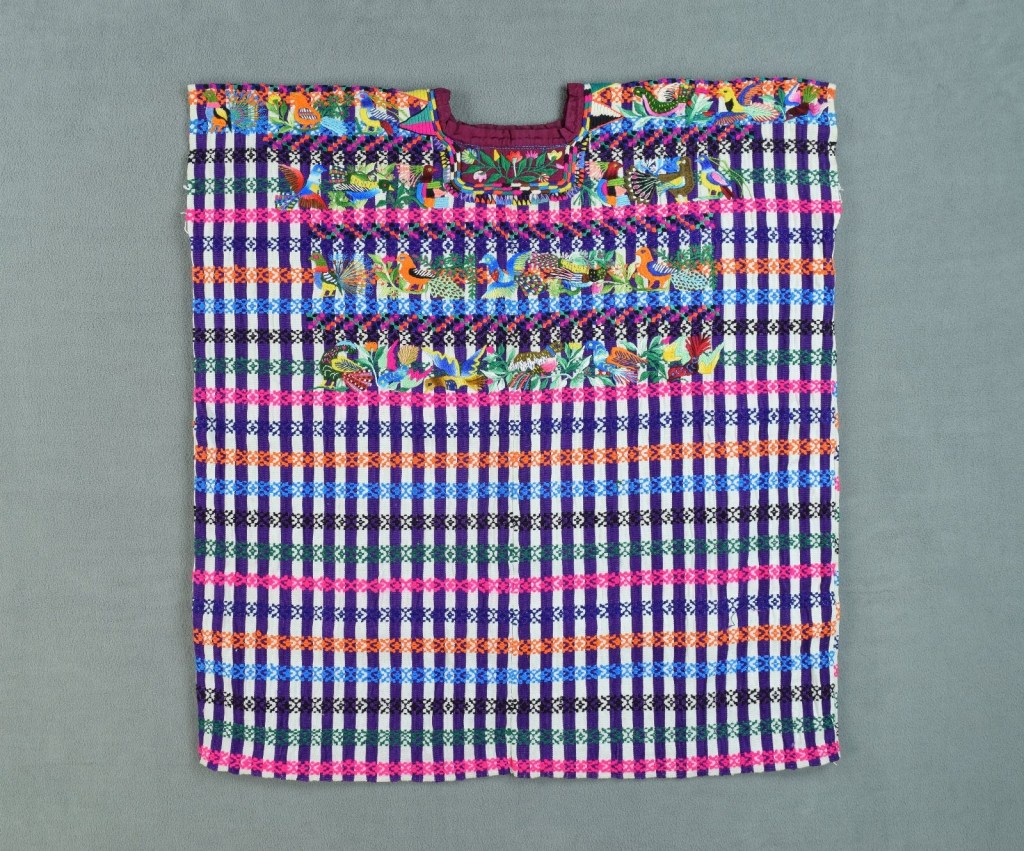
Catalog text for The Art & Art History Collection @ UT Austin
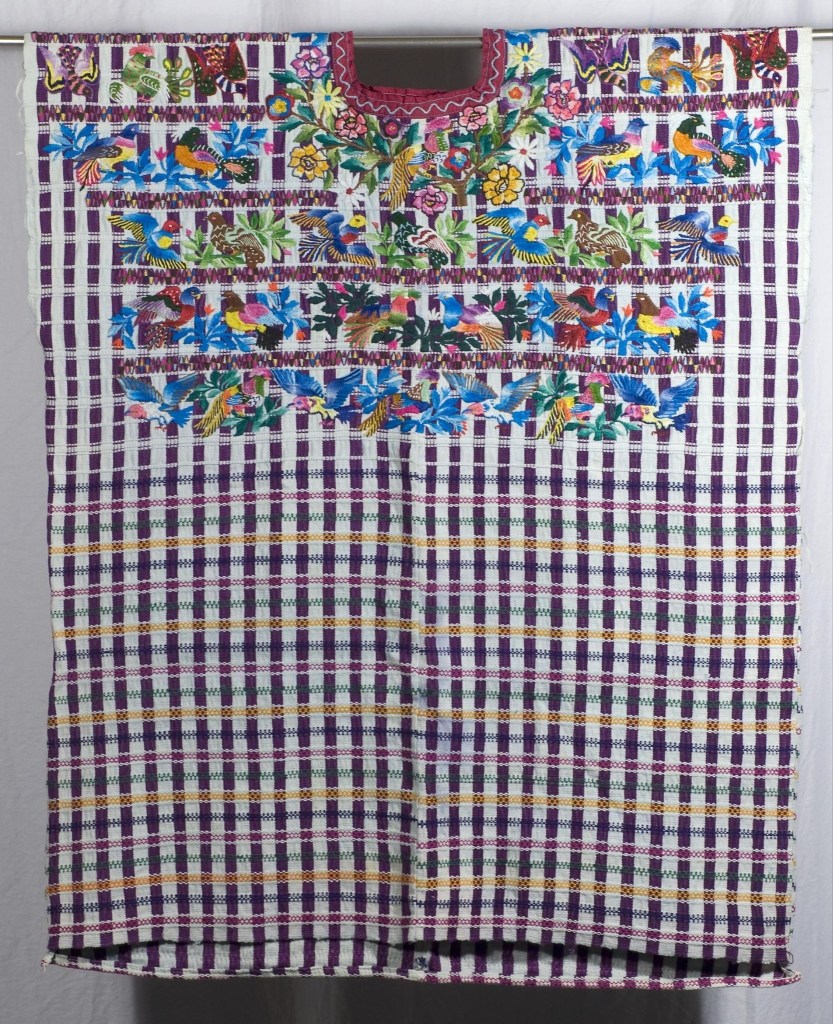
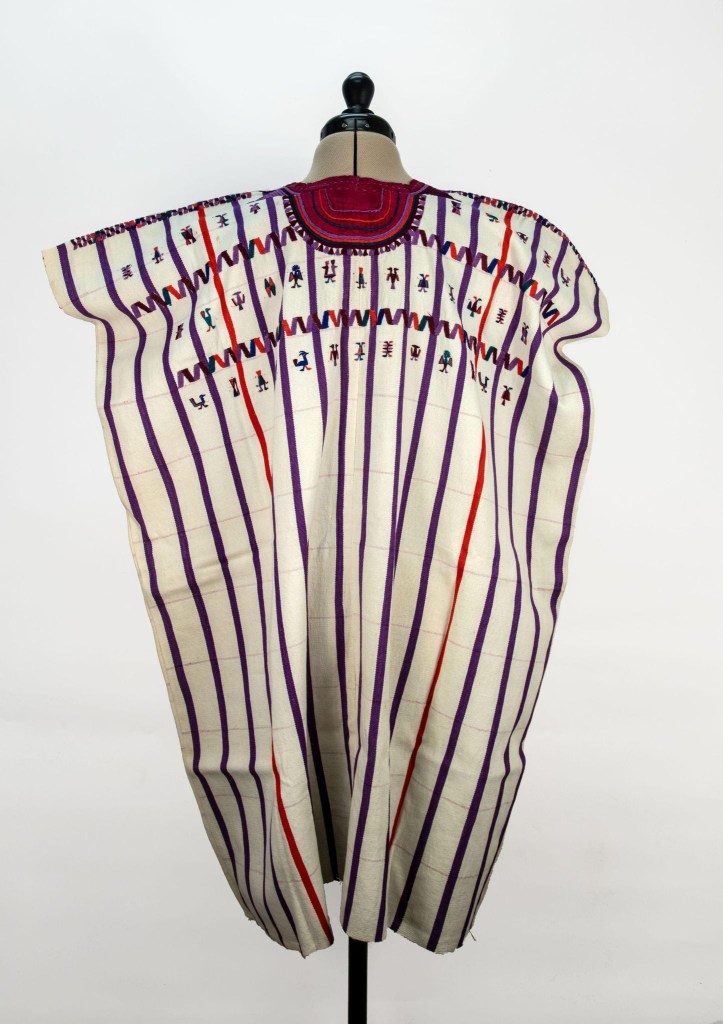
Daily huipiles in Santiago Atitlán are easily identifiable by the embroidered birds that typically occupy the top half of the textile. In this piece in particular (Figure 1), the finely needleworked birds perch on a grid created by white brocaded details overlaid on a mauve-and-white striped background. The chest of the huipil is further decorated with flowers, leaves, and a wide-branched tree that wraps around the neck. When putting on the huipil, the wearer places herself at the center of this cacophony of flora and fauna, recognizable as the luscious landscape of Santiago Atitlán, or The House of the Birds (Tz’ikin Jaay). The neck of the huipil is further embellished with a mauve taffeta trim which is anchored down onto the main body of the piece by light blue stitching. The path of the thread is reminiscent of the volcanoes, mountains, and hills that surround the basin of Lake Atitlán, and in the old style of the regional huipil, the neck is typically bracketed by embroidered conical shapes which more explicitly represent the volcanoes surrounding the Lake (Figure 2).
Tz’utujil communities around Lake Atitlán are characterized by sustaining a cultural continuity that brings ancient Maya traditions into post-Colonial contexts. T’zutujil customs, or costumbres, might be found embedded in traditions that seem Spanish in origin, as is the case with Cofradías (catholic brotherhoods). The ritual of weaving, however, was little affected by Spanish rule, and intimately reflects Tz’utujil worldviews that predate the conquest. Costumbristas hold that Santiago Atitlán is the umbilicus of the world (R’muxux Ruchulew), and holds a centrality that can be associated with the cosmic world tree (Carlsen 2009: 303). The embroidered tree that encroaches upon the neck of the piece is not a common design element in Santiago Atitlán huipiles, which makes this textile remarkably unique. Visible on both the front and back, the tree perhaps alludes to this concept of sacred centrality. Thus, when the wearer puts on the huipil, she not only emerges at the center of the landscape, but at the center of the cosmos itself.
A Tz’utujil textile, from its creation, is an extension of both the natural world and of its maker. When a weaver produces a textile on the backstrap loom, it is said that she gives birth to the cloth (Prechtel & Carlsen 1988: 123). Not only do the back-and-forth movements she performs during the weaving process resemble the motions of procreation, but the loom itself is a human body, anchored by its head (back loom bar, rwa kiem) to the mother tree (R’tie Chie) through its umbilical cord (tie cord, yujkut). The weaver places herself at the feet of the loom (front loom bar, r’chaq kiem) and introduces sustenance (the shuttle, r’way) into the heart (the shed, r’kux) of the textile, animating it as she labors to produce the cloth. At the end of the process, the textile is born between the weaver and the mother tree.
The confection of the daily huipil in the midcentury required two long hip-width panels which combined white, mauve and sometimes orange cotton thread to create the striped base of the huipil. Stripe width could vary depending on the weaver—traditional styles have thin, mauve stripes which are widely spaced out (Fig. 2), while more innovative versions such as this one experiment with stripe width and spacing to produce new compositions. The use of handspun white cotton, or batz’in batz’, is associated with both ancestral renewal and the cult of the syncretic saint/deity Maximón (Carlsen 2009: 308-309).
The mauve color is a distinguishing feature of Santiago Atitlán textiles. This tone of thread can be easily achieved by layering cochineal and indigo dyes, but it is also possible that the weaver sourced this thread from a specialized trader. This tone of mauve has been historically produced using the gland secretions of the Plicopurpura Pansa mollusk, which tends to inhabit the Pacific coast of the hemispheric Americas. Plicopurpura Pansa-dyed thread likely reached the Lake Atitlán region through trade in pre-modern times, and in contemporaneity it is imported from coastal regions in Mesoamerica, including Honduras (O’Neale 1945: 11-12). The imported thread is usually expensive, leading weavers to turn to locally sourced dyes or synthetically colored thread for the sake of thrift. Though it is hard to visually identify if the mauve hue was achieved using a mixture of cochineal and indigo or the more coveted Plicopurpura Pansa dye, it is certain that the weaver of this piece used unmercerized, hand-dyed thread to create the striped pattern.
The style of this 1969 huipil marks a significant aesthetic change in the textiles of Santiago Atitlán. Embroidered birds have been present in most all iterations of the Santiago Atitlán huipil, but before the midcentury they were exclusively small, geometric, and embroidered with a limited color palette of mauves, lilacs, greens, oranges, and other similar hues. Larger grids in traditional textiles allowed the motifs to nest neatly in rows—quetzales, double headed eagles, and peacocks alternate with images of maize plants, hourglasses, and rhomboids. Weavers in Santiago Atitlán and other Lakeside towns perfected styles of embroidery that closely imitate single face brocading. By carefully inserting the needle under just a few warp threads when embroidering, the design is added onto the main body of the cloth much like a supplementary weft (O’Neale 1945: 82). The conventional style of motifs directly alludes to key concepts in the Tz’utujil tradition: the hourglass and the rhomboid remind of the circularity of time and the cosmos, different species of birds regionally place the textile in Tz’ikin Jaay (Santiago Atitlán), and maize plants represent the center of the cosmos (Holsbeke 2003: 34). While this daily huipil seems to break away from the grid in a manner that is almost oppositional to historic Santiago Atitlán textiles, the Tz’utujil costumbre is interwoven into the fibers of this piece. The style of this huipil points towards an interest in the weaving community to incorporate novel technologies and expand the artistry of textile forms while simultaneously being key agents in the transmission of ancestral worldviews and knowledge. Birds similar to the ones depicted can be observed in another piece from the same time (Figure 3), which indicates that designs such as these likely started out as an embroidery pattern. And yet, this weaver’s industry is not lost to novel technologies. Her individual decisions are visible in the gentle ombre of the embroidery, as well as the thoughtfully brocaded accents that will be hidden below the corte when worn. They are also visible in the rows of linked rhombuses, which bring the millenary concept of the Tz’utujil cosmos into a completely contemporary composition. This daily huipil ideally demonstrates the anti-static quality of Maya weaving, and how costumbre can be intimately present even in innovation.